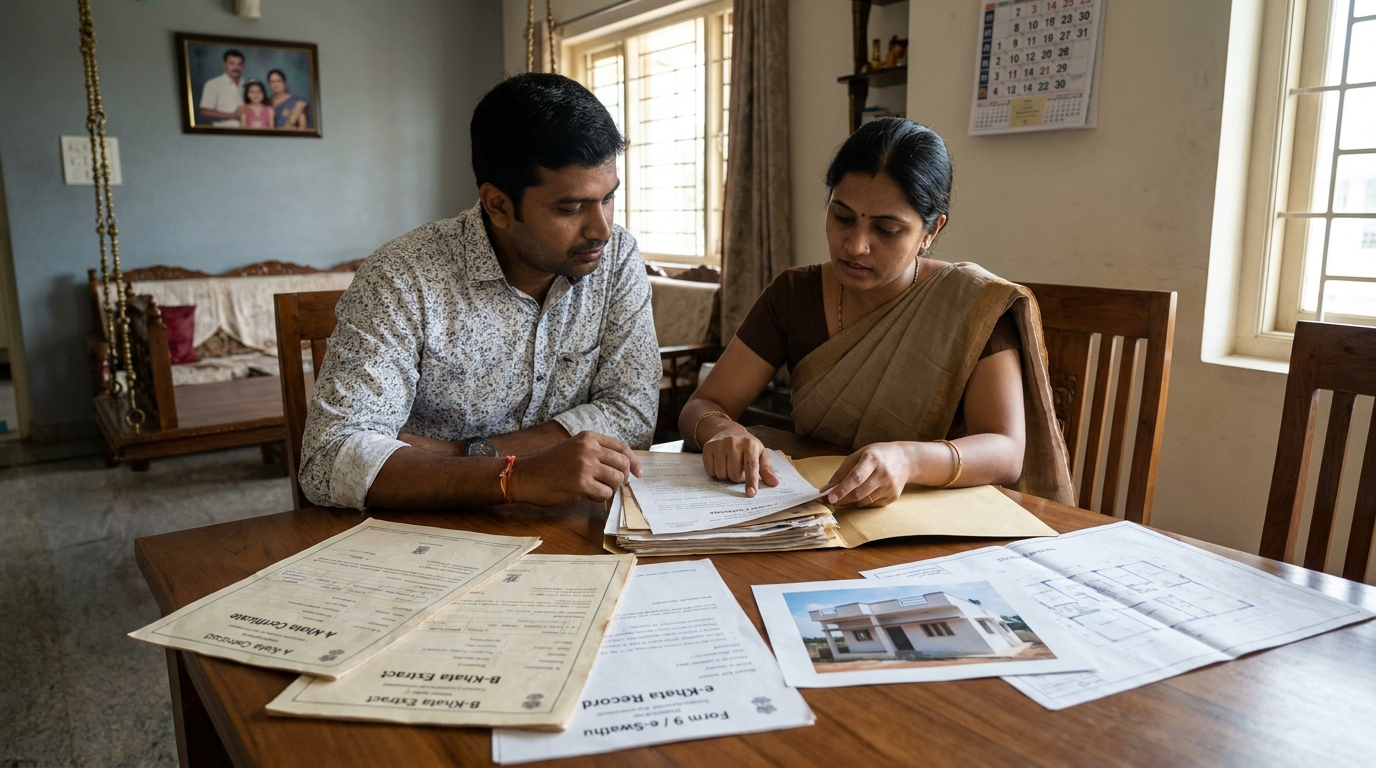
Khata is a property assessment record maintained by your local civic authority in Karnataka - it's proof a property is on the tax rolls, not proof of ownership. Which Khata or property-record type your property has (A-Khata, B-Khata, e-Khata, Form 9/e-Swathu, and others) is one of the biggest factors in whether lenders will consider your home loan application.
This guide explains what each type means, what documents lenders typically ask for, and what to check before you apply - including how a mismatch here can get your home loan rejected.
What is Khata in Karnataka?
Khata is a property assessment record maintained by the relevant local civic authority. Depending on location, this may be a municipal corporation (like Bengaluru's BBMP - Bruhat Bengaluru Mahanagara Palike), a municipality, a City Municipal Council, or a Gram Panchayat.
A Khata or equivalent record typically contains property details, assessment information, and tax-related records. Khata is not the same as a sale deed or title document. Holding a Khata does not, by itself, establish ownership.
Khata types in Karnataka at a glance
| Khata / property record | What it generally means | Home-loan position |
|---|---|---|
| A-Khata | Municipal property assessment record generally associated with compliant properties | Broad lender acceptance, subject to title, technical and credit checks |
| B-Khata | Property recorded for tax/assessment purposes but may have compliance or approval issues | May be considered by selected lenders on a case-by-case basis |
| e-Khata | Digital form of the applicable Khata/property assessment record | Depends on the underlying property documentation and current lender requirements |
| Form 9 / e-Swathu | Panchayat property record for eligible properties in Gram Panchayat areas | May be accepted by lenders subject to property and document assessment |
| Form 11 | Panchayat tax/register record that may accompany Form 9 | Usually a supporting document, not a standalone basis for lending |
| Form 3 / 11B | Records associated with certain converted or incompletely regularised properties | Acceptance can be more restricted and lender-specific |
Khata status types in Karnataka: a closer look
1. A-Khata
A-Khata is generally associated with a property that has the required municipal documentation and approvals for its category, giving borrowers a wide range of lenders to choose from - though it doesn't automatically guarantee approval, since the lender still assesses the property and borrower independently. If you're buying land to build on rather than an already-constructed A-Khata property, our self-construction home loan covers stage-wise disbursal as you build.
The lender can still check:
- Ownership and title
- Previous title documents
- Encumbrance Certificate
- Property tax records
- Approved building plan, where applicable
- Construction status
- Property valuation and technical condition
- Borrower's income and credit profile
2. B-Khata (including BBMP B-Khata in Bengaluru)
B-Khata is commonly associated with properties recorded for assessment/tax purposes but carrying one or more issues relating to approvals, layout, construction, land conversion, or other compliance requirements.
BBMP B-Khata specifically affects properties within Bengaluru's municipal limits - often apartments or independent houses in layouts that were never fully regularised, or built with plan deviations. Because this scenario comes up often for Bengaluru buyers, it's worth treating separately: the underlying reason for BBMP B-Khata status (layout approval gap vs. plan deviation vs. conversion issue) tends to matter more to lenders than the label itself.
The exact reason for a property having B-Khata matters:
- Building-plan deviation
- Layout approval status
- Land conversion
- Construction permissions
- Other regulatory or property-specific matters
Can I get a home loan on a B-Khata property in Karnataka?
Yes - some lenders may consider B-Khata properties, but eligibility is case-specific. Public-sector banks, private lenders, Housing Finance Companies (HFCs), and Non-Banking Financial Companies (NBFCs) each carry different property policies. A lender that accepts one B-Khata property may decline another if the underlying issue or documentation differs - understand the property documentation first, then target lenders whose current policies fit that specific profile.
3. e-Khata
e-Khata is the digital form of the relevant Khata/property assessment record, including BBMP's e-Khata rollout for Bengaluru properties.
e-Khata should not be treated as a guarantee of loan eligibility. A lender may still examine the underlying property documentation, title, approvals, tax records, and construction status. If you hold an older paper Khata, check with the relevant authority and your lender whether digital migration or an updated document is required for your transaction.
4. Form 9 / e-Swathu
Properties in Gram Panchayat areas may use Panchayat records instead of a municipal Khata. e-Swathu is Karnataka's online Gram Panchayat property record system.
Form 9/e-Swathu applies to eligible non-agricultural properties within applicable Panchayat jurisdictions. For a home loan, the lender may ask for Form 9 alongside other Panchayat, title, tax, and land-related documents.
If your income comes from agricultural land or seasonal farm activity rather than a payslip, see how we assess home loans for farmers and agri-income borrowers - RTC (Record of Rights, Tenancy and Crops, the land record used for agricultural or converted land) and seasonal income are accepted as proof.
Can I get a home loan on a Form 9 property?
Yes, potentially - subject to the lender's current policy and the property's documentation, including:
- Property title and land-use status
- Conversion documentation, where applicable
- Panchayat records and tax records
- Construction approvals
- Property valuation
- Borrower's income and credit profile
5. Property with no Khata or civic record
If a property has no relevant municipal or Panchayat record, getting a home loan becomes significantly harder.
Before approaching multiple lenders, find out why the record is missing. Depending on the property, next steps may involve the relevant civic authority or Gram Panchayat, and completing the appropriate documentation or assessment process. The exact path depends on location, land status, and existing documentation.
Can I get a home loan for a Gram Panchayat property?
Potentially, yes. Gram Panchayat properties aren't assessed under the same municipal Khata system used in urban areas.
Relevant records may include:
- Form 9/e-Swathu and Form 11
- Sale deed and previous title documents
- RTC, where applicable
- Conversion documents, where applicable
- Property tax receipts
- Building/construction documents
What documents do lenders check for a Karnataka property?
The exact checklist varies by lender, property, and loan type.
Property documents
- Sale deed and previous title documents
- Khata certificate/extract or applicable Panchayat record
- e-Khata, where applicable
- Form 9/e-Swathu and Form 11, where applicable
- Encumbrance Certificate (EC)
- Latest property tax receipt
- Approved building plan and construction permissions, where applicable
- Land conversion documents, where applicable
- RTC and related land records, where applicable
Borrower documents
- Identity and address proof
- Income documents, bank statements, salary slips or business-income proof, including self-employed applicants without ITR, who are assessed on bank statements and business vintage instead of filed returns
- Existing loan details and credit history
- Other documents requested by the lender
Always confirm the final checklist with the lender handling your application - requirements shift, especially around e-Khata migration and BBMP documentation.
How to improve your Khata documents before applying for a home loan
Step 1: Identify the property record
A-Khata, B-Khata, e-Khata, Form 9/e-Swathu, Form 11, Form 3/11B, or another applicable record.
Step 2: Understand the reason for the classification
For B-Khata and other non-standard documentation, the underlying reason matters more to a lender than the label.
Step 3: Collect the complete property file
Title documents, tax records, EC, approvals, and applicable Khata/Panchayat documents - before approaching a lender.
Step 4: Get a property pre-assessment
A documentation review can surface issues before you submit a full application and trigger a credit inquiry.
Step 5: Match the property with the appropriate lender
The lender right for an A-Khata apartment may not be the best fit for a BBMP B-Khata independent house or a Gram Panchayat property.
What about B-to-A Khata conversion?
If you're considering converting a B-Khata property to A-Khata, check the latest applicable government notification and current requirements of the relevant local authority before deciding - conversion rules, fees, eligibility conditions, and deadlines change, and BBMP's process in particular has been revised multiple times in recent years.
Compare:
- Conversion cost and expected processing time
- Required documents
- Whether the property actually qualifies
- Whether conversion is likely to improve your lender options
- Your home-loan timeline
Khata home-loan eligibility: a quick decision guide
Have A-Khata? You generally get access to a wide range of lenders, subject to normal checks.
Have e-Khata? Confirm the underlying property documentation and the lender's current requirements - the digital format doesn't change what's underneath it.
Have B-Khata (including BBMP B-Khata)? Identify the reason for the classification and look for lenders that consider that specific property profile.
Have Form 9/e-Swathu? Check whether the property and Panchayat documentation meet the lender's requirements.
Have Form 3/11B? Expect more detailed, lender-specific legal and technical assessment.
No Khata or equivalent civic record? Address the property documentation first, before making multiple home-loan applications.
Khata eligibility varies by location, documentation, construction status, and the lender's current policy - and no two lenders treat the same B-Khata or Form 9 property identically. Nivasa Finance works with 10+ lending partners across banks, HFCs, and NBFCs, and matches your specific Khata type and property profile against which of those lenders are actually likely to consider it - before you apply anywhere. That means you're not spending multiple hard credit inquiries testing the market yourself; you go in with a shortlist of lenders whose current policy already fits your property.