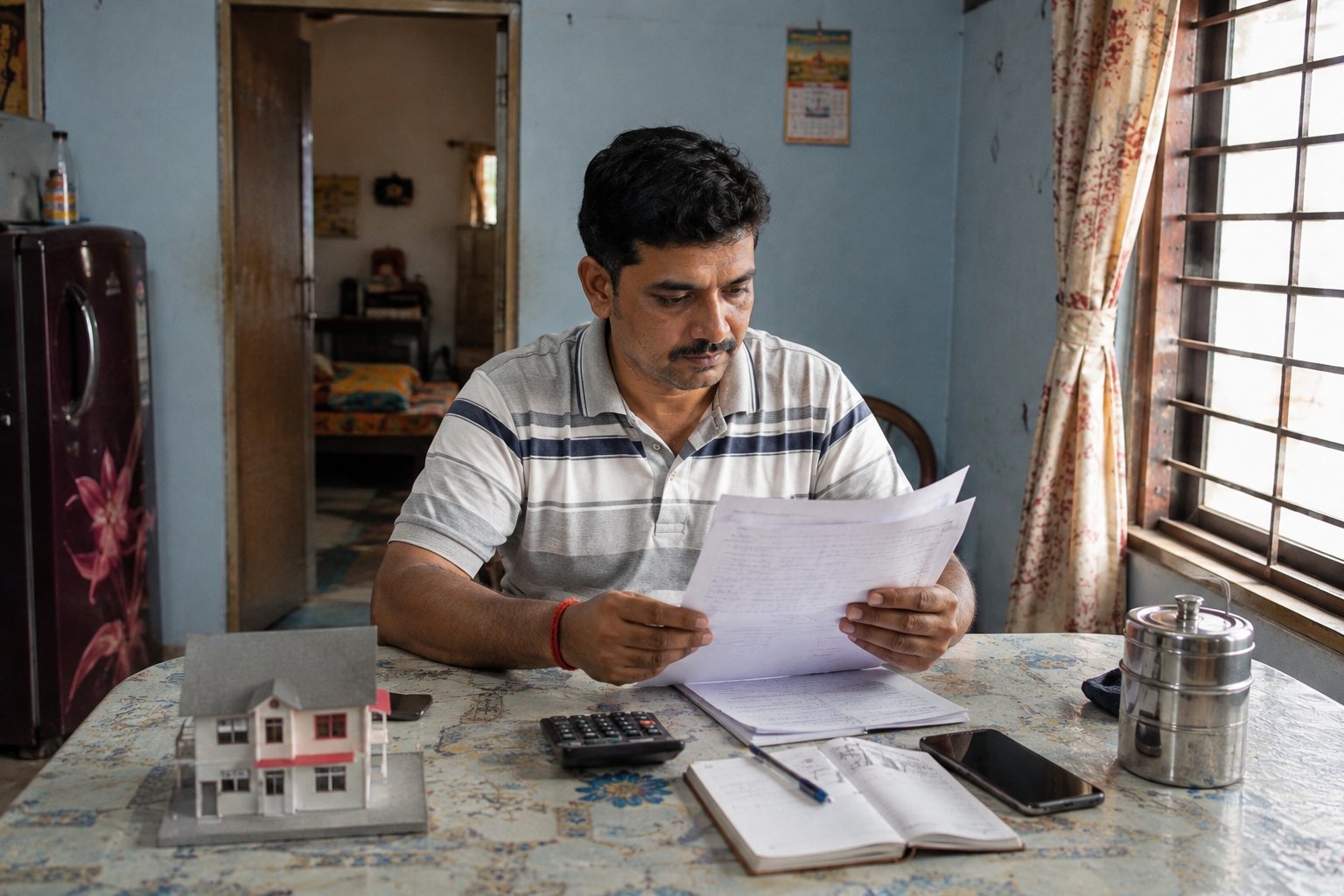
Getting your home loan rejected can be frustrating. You found the home you wanted, arranged your documents, planned your finances. Then, a rejection. The first thought is usually, "Let me try another bank." But pause for a moment first — a rejection doesn't always mean you can't get a home loan. What matters is understanding why it happened.
Common Reasons for Home Loan Rejection in Karnataka
- Your income doesn't support the loan amount. The amount you applied for may simply be higher than what your monthly income can comfortably support, based on the lender's own calculation.
- Even small active loans shrink your loan eligibility. Lenders generally require that your total EMIs — old and new — don't exceed 40–50% of your monthly take-home pay. That's why two people earning the exact same income can receive entirely different loan offers based on their existing liabilities.
- Credit health often outweighs current income at the final approval stage. Most lenders draw a strict baseline around a 700–750 credit score for prime loan terms. If late payments have pushed your score below 650, lender hesitation increases sharply — and these marks can stay on your report for years, overshadowing an otherwise healthy financial profile. Check home loan eligibility if you have a low CIBIL score.
- Your income documents aren't sufficient. Common for self-employed borrowers, where the lender needs more than what was submitted — bank statements, business proof, or CA-certified financials.
- Your business or employment profile may fall short of strict lender guidelines. For self-employed applicants, most lenders want a minimum "business vintage" of 3 continuous years, backed by 2 years of profitable ITRs. Even with high revenue, a business under 36 months old is often classified as high-risk.
- The property has documentation or legal issues. Ownership or approval concerns come up often in Tier-2 and Tier-3 Karnataka, where Khata, RTC, or mutation records aren't always complete.
You can have a strong income and a clean repayment record and still get rejected because of a property title issue — or have a spotless property while your income-to-EMI balance or credit history is the real problem. First figure out whether the concern is your profile, the property, or the paperwork. They need very different fixes.
How Long Does Each Issue Take to Fix?
- Documentation gaps — missing Khata, incomplete mutation — can sometimes resolve in a few weeks, depending on how far the paperwork already is.
- Too many existing EMIs can often be fixed fast — closing a small loan or applying for a lower amount can bring your eligibility back up almost immediately.
- Credit history issues usually take longer — generally a few months of consistent, on-time repayment.
- Self-employed income documentation is often less about time, more about approach — the right mix of statements and proof can resolve it on the next application, with the right lender.
Don't Apply to Every Bank at Once
Switching lenders without understanding what went wrong rarely helps, and adds unnecessary marks to your credit report. Different lenders weigh income, credit history and documentation differently, so a salaried employee and a self-employed professional with similar incomes can get very different outcomes.
What to Check Before You Reapply
- Is your income properly documented for the amount you need?
- Are your existing EMIs too high for a new one to fit comfortably?
- Does your credit history need cleaning up?
- Are your property's documents actually in order?
Knowing where you stand makes your next application stronger.
Where Nivāsa Comes In
Figuring out which of these applies to you, and which lender is likely to see your profile differently, isn't always easy alone. At Nivāsa Finance, we look at your income, obligations, documents, property and requirement — and help you explore options across 10+ lending partners regulated by the RBI, with no commission charged to customers. Apply for a loan right now. Final approval and loan amount always remain at the discretion of the partner bank or NBFC.