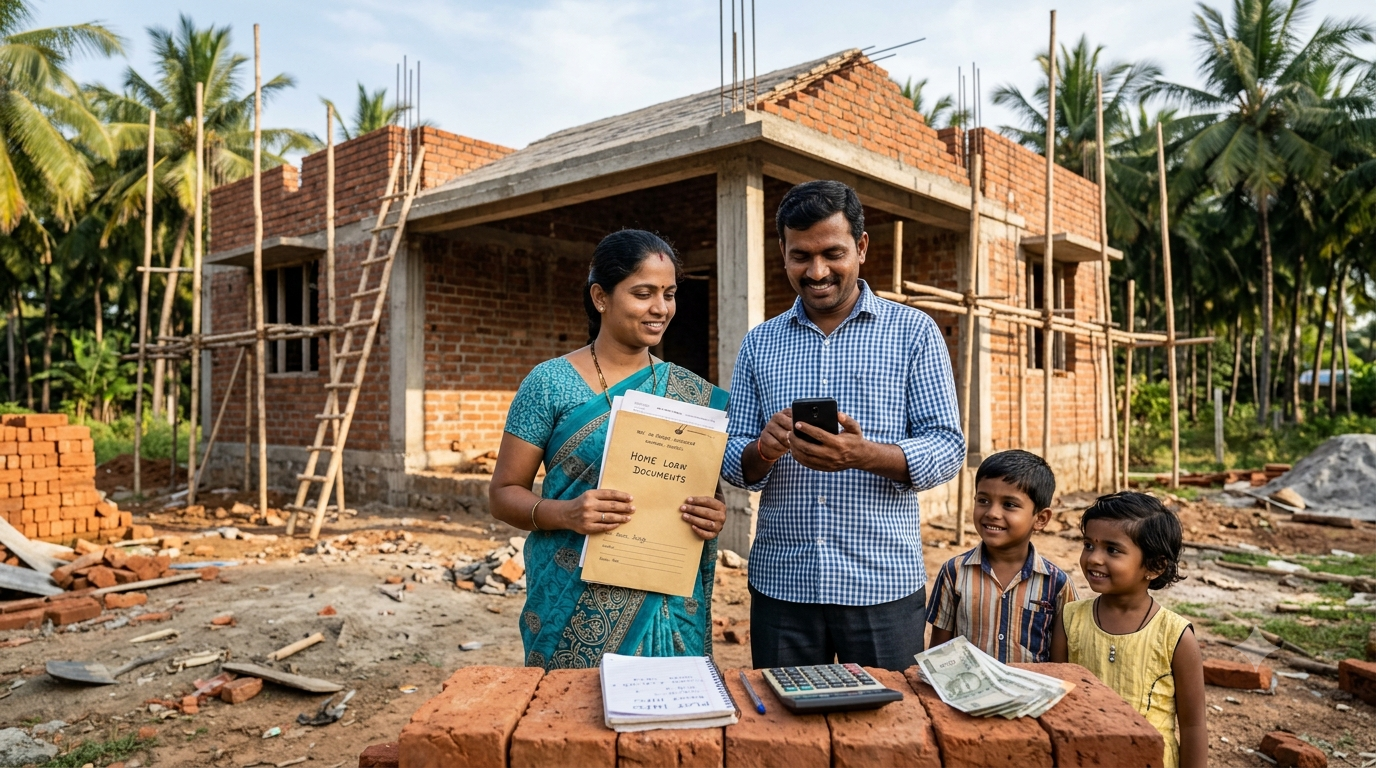
The right home loan for you depends on three things: what you need the money for, how your income can be shown, and what documents your property has. In 48,625 loan enquiries Nivasa Finance received across Karnataka, 57.4% of families wanted to build a house on land they already own — and among applicants we screened, the factor that most often decided the outcome was the credit score, not the property papers.
This guide explains each of the three factors in plain language, using real numbers from Nivasa Finance enquiries, and tells you what to fix first if you want a better offer.
All figures in this guide come from 186,475 loan enquiries received by Nivasa Finance, a zero-commission home loan advisor operating in 23 districts of rural and semi-urban Karnataka (see our home loan guide for rural Karnataka), between September 2024 and September 2026. Not every detail is recorded for every enquiry, so each figure states the number of enquiries it is based on.
- Most families are building, not buying. 57.4% of enquiries were for house construction; only 2.4% were for buying a ready house (48,625 enquiries).
- Most applicants do not have formal income papers. 51.1% earn a cash salary with no ITR and no salary credits in a bank account; only 27.3% had three years of ITR (7,123 enquiries).
- Credit score is the biggest hurdle. 65.4% of credit-related rejections were due to a low credit score; property documents caused 4.9% (20,336 rejections).
- No credit history is better than a poor one. Applicants with no credit score received an offer 39.6% of the time; those scoring below 650 received one 22.5% of the time.
- B-Khata is not a dead end. B-Khata applicants received offers at a similar rate to A-Khata applicants (44.3% vs 39.9%). Having no khata at all dropped it to 14.1%.
What do people in Karnataka take home loans for?
Most borrowers in rural and semi-urban Karnataka are building a house on land they already own. Buying a ready-built house is rare outside cities. Here is what people asked for when they enquired with Nivasa Finance:
| What the loan is for | Share of enquiries | Which loan fits |
|---|---|---|
| Building a house on own land | 57.4% | Home Construction Loan |
| Personal needs (education, medical, family events) | 13.7% | Loan Against Home/Property |
| Business needs | 9.5% | Loan Against Home/Property |
| Moving an existing loan, with or without extra money | 8.3% | Balance Transfer + Top-Up |
| Repairing or extending an existing house | 5.7% | Home Improvement Loan |
| Buying a ready-built house | 2.4% | — |
| Closing other loans | 1.5% | Loan Against Home/Property |
| Buying a plot and building on it | 0.8% | — |
| Buying a plot only | 0.7% | — |
Based on 48,625 enquiries to Nivasa Finance where the loan purpose was recorded, September 2024 – September 2026.
The amount people need is also modest. The middle (median) amount requested was ₹10 lakh, and 81.9% of requests fell between ₹5 lakh and ₹50 lakh (94,230 enquiries with a requested amount).
What this means for you: if you own the land, a Home Construction Loan is usually the right product. The money is released in stages as construction progresses, not all at once — see our guide to self-construction home loans in Karnataka for stage-wise disbursal and documents. If the house already exists and needs a new roof, an extra floor or repairs, a Home Improvement Loan fits better. For any other purpose — business, education, medical, clearing costly debt — a Loan Against Property uses your existing house as security. It usually costs more than a home loan because the money can be used for anything.
This matters more than it sounds: in our data, 36.1% of the houses applicants already lived in had sheet or tiled roofs rather than RCC (23,175 enquiries with house type recorded). For many families the real need is upgrading an existing house, not building from scratch.
How does your income type change which home loan you can get?
Your income type decides which lenders will look at your file and which documents they will ask for. You do not need a salary slip to get a home loan. But the fewer formal records you have, the smaller the group of lenders that will consider you. Here is how the applicants who told us their income type break down:
| Income type | Share of applicants |
|---|---|
| Cash salary — no ITR, no salary credited to a bank account | 51.1% |
| Salaried with bank credits, or self-employed with 3 years of ITR | 27.3% |
| Self-employed — no ITR, but income visible in bank/UPI transactions | 14.8% |
| Daily wage or farm labour, paid in cash | 4.4% |
| Farming income from cash crops | 2.4% |
Based on 7,123 enquiries to Nivasa Finance where the applicant's income type was recorded, November 2024 – August 2026.
In other words, roughly 7 in 10 applicants did not have the payslip-and-ITR profile that most loan advice online assumes. If that sounds like you, see our pages on home loans for cash income and self-employed borrowers.
Which documents do lenders use for each income type?
| Income type | What lenders usually look at | What helps most |
|---|---|---|
| Salaried, paid into a bank account | Salary slips and 6–12 months of bank statements | Keep existing EMIs low; this profile has the widest choice of lenders |
| Salaried, paid in cash (cash-income loans) | Employer letter, any bank deposits, household expenses and assets | Deposit your salary in a bank account every month — regular deposits build a record lenders can use |
| Self-employed with ITR | 2–3 years of ITR, business bank statements | Lenders can only count the income shown in your ITR — under-declaring income lowers the loan you can get |
| Self-employed without ITR | Bank and UPI transaction history, business proof (shop licence, GST, trade licence) | Route business payments through one bank account; start filing ITR now |
| Farming income | RTC (the land record showing ownership and crops), crop sale receipts, bank credits | Keep crop sale receipts and deposit sale proceeds in your bank account |
A common misunderstanding about farming income: agricultural income is exempt from income tax, but it is not invisible. If you earn more than ₹5,000 a year from farming and you file an ITR, you are required to declare it there. Declaring it gives lenders a documented record of income they can rely on.
Does your credit score matter more than your property documents?
Yes — in our data, credit score was the single biggest reason loans were declined. A credit score (often called a CIBIL score) is a three-digit number between 300 and 900 that credit bureaus calculate from how you have repaid past loans and credit cards. Higher is better.
When a loan was declined for a credit-related reason, this is why:
| Reason the loan was declined | Share of credit-related rejections |
|---|---|
| Low credit score | 65.4% |
| Income too low for the loan amount asked | 21.5% |
| Too many existing EMIs compared to income | 4.7% |
| House planned on agricultural land that is not converted | 3.5% |
| No proof of income | 3.1% |
| Property did not meet the lender's technical norms | 1.4% |
| Income stated did not match documents | 0.4% |
| Existing loan overdue | * |
Based on 20,336 Nivasa Finance enquiries declined for a credit, income or property reason, September 2024 – September 2026. Enquiries that dropped off, were outside our service area or closed for operational reasons are excluded. * Fewer than 30 cases; not reported.
Property and documentation problems together accounted for only 4.9% of these rejections. Credit score and income accounted for over 90%. For the district-by-district picture, see our data on why home loans get rejected.
What credit score do you need for a home loan?
There is no single cut-off, but the chances of getting an offer rise steadily with your score. Among the applicants we screened:
| Credit score | Applicants who received a loan offer | Applicants |
|---|---|---|
| 750 and above | 48.9% | 3,694 |
| 700 – 749 | 46.3% | 5,854 |
| 650 – 699 | 41.7% | 2,914 |
| 300 – 649 | 22.5% | 9,870 |
| No credit score (never borrowed formally) | 39.6% | 8,480 |
Based on Nivasa Finance enquiries with a credit bureau check and an expert-screening outcome, January 2025 – September 2026. "Loan offer" means a preliminary offer after expert screening.
Two things stand out. First, having no credit history hurts far less than having a poor one — first-time borrowers received offers almost as often as people scoring 650–699, and nearly twice as often as people below 650. Second, a higher score improves the price, not just the chance of approval: offers made to applicants scoring 750+ were nearly three times as likely to fall in the lower interest-rate band as offers made to applicants below 650.
Low scores are common in this group: of the 22,332 applicants with a bureau score, 44.2% scored below 650 and 16.5% scored 750 or above. The median score was 676. For a fuller breakdown, see what credit score you need for a home loan in Karnataka.
What this means for you: before you apply anywhere, check your score and clear any overdue EMI or credit card dues. Each lender that checks your credit adds an enquiry to your report, so applying to several lenders one after another can lower your score further. A single advisor who compares lenders for you avoids this — here is how the multi-lender model differs from applying directly to a bank.
Which property documents do you need for a home loan in Karnataka?
Lenders need proof that the property is legally yours and that a house can legally be built or exist on it. In Karnataka this proof is the khata — the property record kept by your local body (municipality or gram panchayat) that shows who owns the property and that property tax is paid. Here is what applicants told us they had:
| Property record the applicant had | Share of applicants | Received a loan offer |
|---|---|---|
| A-Khata | 35.3% | 39.9% |
| B-Khata | 19.7% | 44.3% |
| Form 3 (e-Khata issued by a town or city municipality) | 7.2% | 37.8% |
| No khata | 8.9% | 14.1% |
| Did not know their khata type | 28.8% | 37.1% |
Share of applicants: based on 32,660 Nivasa Finance enquiries with khata type recorded, January 2025 – September 2026. Offer rate: based on 27,797 of those enquiries that completed expert screening.
B-Khata is not a dead end. A B-Khata means the property is recorded for tax but has a deviation from approval norms — for example, a layout that was not formally approved. Many people assume no lender will accept it. In our data, B-Khata applicants received a loan offer as often as A-Khata applicants. Offer rates do not show loan amount or interest rate, which can still differ between the two. Our guide to Khata types and home loan eligibility in Karnataka explains A-Khata, B-Khata, e-Khata and Form 9 in detail.
Having no khata is the real problem. Applicants without any khata received an offer only 14.1% of the time. If your property has no khata, applying for one before applying for a loan is the most useful single step you can take.
Nearly 3 in 10 applicants did not know their khata type. Find out before you apply — ask your gram panchayat or municipality office, or check the e-Swathu portal (for gram panchayat properties) or the e-Aasthi portal (for town and city municipalities).
Can you get a home loan to build a house on agricultural land?
Not until the land is converted for non-agricultural use. In Karnataka this conversion is ordered by the Deputy Commissioner and is commonly called DC conversion. Without it, lenders cannot accept the land as security for a home loan. In our data, construction on unconverted agricultural land was the reason for 71.8% of all property-related rejections (990 property-related rejections). If your land is agricultural, complete the DC conversion before you apply.
What about gram panchayat properties?
Properties in villages under a gram panchayat are recorded on the state's e-Swathu system as Form 9 or Form 11, instead of a municipal khata. Which form your property has — and whether the land underneath is converted — decides which lenders will accept it. Bring both your e-Swathu extract and your land record (RTC) when you apply.
Should you take a new loan or a balance transfer?
A balance transfer moves your existing home loan to a new lender, usually to get a lower interest rate. A top-up is extra money borrowed on top of the transferred loan, using the same house as security. Both need a different check from a new loan, because the new lender looks closely at how you have repaid your current loan.
| New loan | Balance transfer | |
|---|---|---|
| What decides approval | Your income, credit score and property | The same, plus your repayment record on the current loan |
| Repayment record needed | No previous loan needed | Usually 12 months or more of on-time EMIs |
| Property checked again | Yes | Yes — the new lender does its own legal and valuation check |
| Fees | Processing, legal and valuation fees | The same fees again, at the new lender |
| Key question | Which lender accepts my profile? | Does the saving exceed the cost of switching? |
Balance transfers are harder to get than many people expect. In our data, 18.0% of home loan balance-transfer applicants received an offer after screening, compared with 30.3% of new home loan applicants (1,406 and 21,538 screened applicants).
Is a home loan balance transfer worth it?
Only when the interest you save over the rest of the loan is clearly more than the total cost of switching. Work it out before you apply:
- Ask your current lender for the outstanding amount and the years remaining.
- Calculate the total interest left at your current rate and at the new rate, for the same remaining years.
- Subtract the new lender's processing, legal and valuation fees from the difference.
- If what is left is small, the transfer is not worth the paperwork.
Prepayment charges: under RBI rules, lenders cannot charge a prepayment or foreclosure fee when an individual repays a floating-rate home loan early, including when the loan is moved to another lender. From 1 January 2026, RBI extended this to all floating-rate loans taken by individuals for non-business purposes, sanctioned or renewed on or after that date. Fixed-rate loans can still carry a charge — check your loan agreement.
Do not accept a longer tenure at the new lender just to lower your EMI. A longer loan means more total interest, which can cancel out the saving from the lower rate.
How can you get a better interest rate on your home loan?
Interest rates are not fixed prices. Each lender prices a loan within a range, and your profile decides where in that range you land. The levers differ by situation.
If your credit score is below 650
- Clear any overdue EMI or credit card dues first — in our data a low score is the most common reason for rejection.
- Avoid applying to several lenders in a row; each hard enquiry is recorded on your credit report (see DSA vs direct bank).
- Consider applying with a co-applicant who has a stronger score and income.
If your income is in cash or not in ITR
- Getting to a lender that assesses your income type matters more than negotiating the rate.
- Put your income through one bank account every month — regular deposits are the evidence lenders can use. See how lenders assess cash income and self-employed income without ITR.
- Once you are with the right lender, ask for a waiver or reduction of the processing fee; fees are often easier to negotiate than the rate.
If your property is B-Khata, Form 3 or gram panchayat
- If the property can be upgraded to A-Khata, doing it before you apply widens your choice of lenders.
- Work with someone who knows which lenders are currently accepting your property type in your district — your nearest Nivasa Finance branch can tell you.
If you are moving an existing loan
- Ask your current lender to reduce your rate first — many will, rather than lose a borrower who pays on time.
- If they refuse, get the new lender's sanction in writing and show it to your current lender before switching.
If you have a 750+ score and salary in a bank account
- Get written offers from at least two lenders and ask each to match the better one.
- Keep your total EMIs low compared with your income — lenders call this FOIR (fixed obligation to income ratio), the share of your monthly income already going to EMIs.
How does Nivasa Finance help you choose the right home loan?
Nivasa Finance is a home loan advisor for families in rural and semi-urban Karnataka. We do not lend directly. We assess your income, credit and property, then match your file to lenders in our network of RBI-regulated partner banks and NBFCs that accept your profile.
- Zero commission: you pay no broker fee to Nivasa Finance.
- Loan amounts: ₹5 lakh to ₹50 lakh.
- Products: Home Construction Loan, Home Improvement Loan, Loan Against Home/Property, and Balance Transfer + Top-Up.
- Income types we work with: dairy and farming income, rental income, daily wage, cash salary, self-employed without ITR, salaried without PF, small business owners, government employees, and any income visible in a bank statement.
- Where we work: 23 districts, with branches in Mysuru, Mandya, Hassan, Hosapete, Davanagere, Belagavi, Hubballi, Bagalkot, Shivamogga, Raichur and Tumkur.
Not sure where to start? Find your nearest branch, check your eligibility online, or read our home loan FAQ.