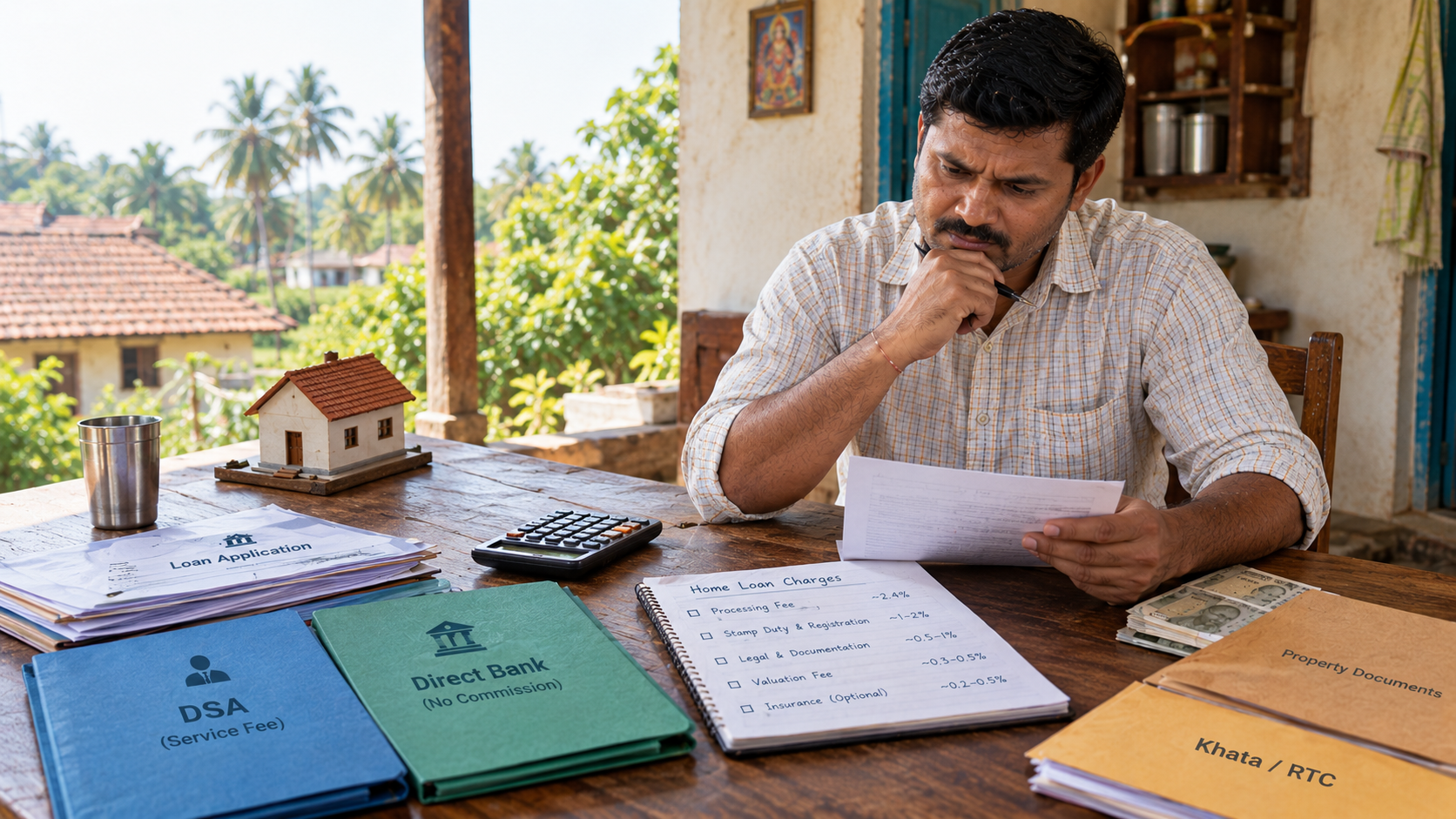
Apart from interest, most of what a home loan costs goes to three places: a processing fee to the lender, stamp duty to the government, and an insurance premium to an insurer, but only if you choose to take it. On 300+ loans approved by Nivasa Finance's partner lenders, the lenders' one-time charges came to a median of 2.4% of the loan before optional insurance (about ₹23,600 on a ₹10 lakh loan). Nivasa Finance charged no commission on any of them.
This guide goes through every charge you are likely to see: who receives it, what it usually costs, which ones you can negotiate or skip, and what RBI rules protect you. If you know these numbers before you apply, nothing on your sanction letter should come as a surprise.
Fee figures are based on 311 loans approved through partner lenders of Nivasa Finance (applications from September 2024 to September 2026) and processing-fee figures on 272 loans disbursed between December 2024 and September 2026. Nivasa Finance is a zero-commission home loan advisor working in 23 districts of rural and semi-urban Karnataka.
- Nivasa Finance charges zero commission. Every charge below is paid to the lender, the government or an insurer.
- The lender's processing fee is usually 2% plus 18% GST (₹23,600 on ₹10 lakh). Two in three borrowers paid this much or less.
- Loan insurance is your choice. 47.6% of borrowers did not take it, and their total one-time lender charges were a median 2.2% of the loan.
- MODT stamp duty in Karnataka is 0.5% of the loan amount since February 2024 (₹5,000 on ₹10 lakh).
- Registration fee on property purchases doubled to 2% from 31 August 2025.
- A lender cannot charge a fee that is not in your Key Fact Statement without your explicit consent (RBI, for loans sanctioned from 1 October 2024).
How much does a home loan cost upfront in Karnataka?
The table below shows what lenders in our network of RBI-regulated partner banks and NBFCs charged on loans arranged through Nivasa Finance. We publish it so you can plan with real numbers instead of guesses. Our own commission on every one of these loans was ₹0.
| Charge | Paid to | Median | Middle half paid | Loans |
|---|---|---|---|---|
| Nivasa Finance commission | Nivasa Finance | ₹0 | ₹0 | All |
| Processing fee (incl. 18% GST) | Partner Lender | 2.36% of loan | 1.76% – 2.92% | 272 |
| Other one-time charges (such as legal and valuation) | Partner Lender | 0.47% of loan | 0.27% – 0.69% | 148 |
| Lender charges before optional insurance | Partner Lender | 2.36% of loan | 1.87% – 2.95% | 311 |
| Loan insurance premium (optional) | Partner Lender | 3.12% of loan | 2.04% – 4.09% | 196 |
Source: Nivasa Finance loan records. Processing fee: 272 loans disbursed Dec 2024 – Sep 2026. Other rows: loans approved from applications made Sep 2024 – Sep 2026. The "before optional insurance" row adds processing fee and other charges per loan; it excludes the login fee and MODT stamp duty unless the lender included them in other charges. "Middle half" means 25% of borrowers paid less and 25% paid more.
Two things are worth knowing before you read that table. The processing fee is usually 2% of the loan plus 18% GST, which is why a ₹10 lakh loan shows ₹23,600 and not ₹20,000. The GST goes to the government. And loan insurance is the biggest single item, yet it is optional. Borrowers who chose not to take it paid a median 2.2% of the loan in total lender charges (117 loans). If you do want cover, you can compare the lender's plan with your own term insurance. We cover that in the insurance section below.
Why is the interest rate not the full cost of your loan?
Interest is charged only on the money you owe. Fees, insurance and stamp duty come on top of it. The number that rolls them all together is the APR (Annual Percentage Rate), the yearly cost of the loan including interest and every lender charge.
Since 1 October 2024, RBI requires every bank, NBFC and housing finance company to hand you a Key Fact Statement (KFS) before you sign a new home loan. The KFS is a short, standard summary: loan amount, interest rate, APR, every fee, and the total you will repay. Charges collected for third parties, such as insurance and legal fees, have to be shown too. A lender cannot charge you any fee that is not in the KFS without your explicit consent. So ask every lender for the KFS and compare APRs, not just interest rates. If the rate itself is what you want to bring down, see how to get a better interest rate on your home loan.
What charges do you pay before your loan is released?
What is a home loan processing fee, and can you negotiate it?
The processing fee covers the lender's work in assessing your application. It is a percentage of the loan amount, with 18% GST added. On loans arranged through Nivasa Finance, lenders charged a median 2.36% including GST, and a quarter of borrowers paid 1.76% or less. That gap tells you there is room to negotiate. A strong credit score, clean bank statements and a lower loan-to-income ratio all give you grounds to ask for a reduction. Ask before you accept the sanction letter, not after.
What is a login fee?
A login fee is a small charge collected when your file is formally submitted ("logged in") to the partner lender for assessment, before the processing fee. In our records it was most often between ₹1,180 and ₹3,000, with a median of ₹2,360. Nivasa Finance staff help you make this payment, but it goes directly to the lender partner's bank account. The fee is standard across lenders and is usually non-refundable, even if the loan is not approved later.
What are legal and valuation charges?
Before lending, the lender appoints a lawyer to check that the property title is clear, and an engineer or valuer to assess what the property is worth. The lender lends against the valued amount, not the price you paid or the cost you estimate, so if the valuation comes in lower, the loan you are eligible for drops. A clean title helps here, and our guide to Khata types and home loan eligibility explains which property documents lenders look for. On loans arranged through Nivasa Finance, these other one-time charges came to a median 0.47% of the loan, under ₹5,000 on ₹10 lakh. For construction loans, the lender's engineer usually inspects again before each stage of money is released.
What is MODT and how much stamp duty do you pay on it in Karnataka?
MODT (Memorandum of Deposit of Title Deeds) is the document that records you have handed your original property papers to the lender as security. In Karnataka it attracts stamp duty, which goes to the government and not the lender.
Since the Karnataka Stamp (Amendment) Act was notified on 3 February 2024, stamp duty on deposit of title deeds is 0.5% of the loan amount (minimum ₹500). Before that it was 0.1% for loans up to ₹10 lakh and 0.2% above, with a cap, which is why many websites still quote the old rate. On a ₹10 lakh loan that works out to ₹5,000, plus a registration fee charged by the Sub-Registrar. This charge is not negotiable.
What is pre-EMI interest on a construction loan?
If you are building, the lender releases money in stages as the work progresses. Until the full loan is released and your regular EMI starts, you pay interest only on the amount released so far. That is pre-EMI interest. It is not a fee, but it is real money, and it does not show up in your EMI schedule. Our guide to self-construction home loans in Karnataka explains stage-wise release in more detail.
Here is an example for illustration. A ₹10 lakh construction loan released in four equal stages of ₹2.5 lakh, three months apart, at an example interest rate of 14% a year, adds about ₹87,500 in pre-EMI interest over the first year. Building faster reduces it, and long gaps between stages increase it. Ask the lender for a stage-wise pre-EMI estimate before you sign.
Is home loan insurance mandatory?
Usually not, and from 1 January 2027 commercial banks are explicitly barred from forcing it. Under RBI's Responsible Business Conduct directions for commercial banks (amended June 2026), a bank cannot make you buy insurance or any other third-party product to get a loan. Where insurance is genuinely needed to protect the loan, you can buy it from any insurer you choose. Whatever your lender type, if someone tells you insurance is compulsory, ask for that condition in writing.
Borrowers do use this choice. On loans arranged through Nivasa Finance, 47.6% of approved borrowers did not take loan insurance. Those who did paid the insurer a median premium of 3.12% of the loan, about ₹31,000 on ₹10 lakh, for cover that repays the loan if something happens to the borrower. Before you decide, ask:
- Is it optional? Get the answer in writing.
- Is the premium added to the loan? If so, you pay interest on the premium for the whole tenure.
- Does the cover reduce as the loan reduces? A reducing cover matches a loan. A level cover for the full tenure usually costs more.
- Can you use your own term insurance instead? A separate term plan assigned to the lender is often cheaper, so compare before you sign.
Some lenders also ask you to insure the house itself against fire and similar damage. That is separate from loan insurance, and you can generally pick your own insurer.
What are stamp duty and registration charges on buying a property in Karnataka?
If you are buying a property, you pay stamp duty and registration on the sale deed. These sit apart from all the loan charges above. If you are building on land you already own, which is what 57.4% of families enquiring with Nivasa Finance wanted (see which home loan is right for you), there is no sale deed and these charges do not arise.
| Property value | Stamp duty | Registration fee |
|---|---|---|
| Up to ₹20 lakh | 2% | 2% |
| ₹20 lakh – ₹45 lakh | 3% | 2% |
| Above ₹45 lakh | 5% | 2% |
Charged on the higher of the sale price and the government guidance value. A surcharge and cess may be added on top of stamp duty depending on where the property is. Registration fee rose from 1% (capped at ₹30,000) to 2% for documents registered from 31 August 2025. A gift of property to a spouse, parent or child pays a fixed concessional stamp duty instead of a percentage. Confirm current figures on the Kaveri portal (kaveri.karnataka.gov.in) or at your Sub-Registrar office before you budget.
On a ₹30 lakh house, that comes to ₹90,000 in stamp duty and ₹60,000 in registration, so ₹1.5 lakh before any surcharge or cess, all of it paid to the government. Budget for it separately, because lenders do not usually finance it.
What charges can you face after the loan is released?
Are there prepayment or foreclosure charges on a home loan?
Not on a floating-rate home loan taken by an individual. RBI rules do not allow lenders to charge a fee when you repay such a loan early, in part or in full, including when you move it to another lender through a balance transfer. From 1 January 2026, RBI extended this to all floating-rate loans taken by individuals for non-business purposes, for loans sanctioned or renewed on or after that date. Fixed-rate loans can still carry a charge, so check the foreclosure clause in your KFS. If you plan to prepay, our guide on how to reduce your home loan EMI covers prepayment, tenure and the balance transfer break-even.
How quickly must the lender return your property papers?
Within 30 days of your final repayment. RBI rules in force since 1 December 2023 require banks and NBFCs to return your original property documents within 30 days of full repayment, and to pay you ₹5,000 for every day of delay caused by the lender.
Are there any other ongoing charges?
Some lenders charge for switching your interest rate scheme, for statements, or for annual account maintenance. Every such charge must be listed in your KFS. If it is not there, ask before you sign.
What does a ₹10 lakh home loan cost upfront? A worked example
₹10 lakh is the median amount requested by families who enquired with Nivasa Finance (94,230 enquiries). Using the median charges from our data, here is what you would pay and to whom:
| Charge | Paid to | Amount | Can you avoid or reduce it? |
|---|---|---|---|
| Nivasa Finance commission | Nivasa Finance | ₹0 | N/A |
| Processing fee (2% + 18% GST) | Lender (GST to government) | ₹23,600 | Negotiable. Ask before you accept |
| Login fee (median) | Lender | ₹2,360 | Ask if it is refundable |
| Other one-time charges, such as legal and valuation (median 0.47%) | Lender | ₹4,700 | No. Set by the lender |
| MODT stamp duty (0.5%) | Government | ₹5,000 | No. Registration fee is extra |
| Total you pay | ₹35,660 | ||
| Loan insurance (median 3.12%), only if you choose it | Insurer | ₹31,200 | Optional. Compare with your own term plan |
Illustration built from median values in Nivasa Finance loan records. Your actual charges depend on the lender, your profile and the property. Pre-EMI interest on construction loans is additional.
What should you ask before signing a home loan?
| Ask the lender | Why it matters |
|---|---|
| Can I have the Key Fact Statement? | Required by RBI. Lists every fee and the APR. Fees not in it cannot be charged without your consent. |
| What is the APR? | The only fair way to compare two lenders. |
| What is the processing fee, including GST? Can it be reduced? | The most negotiable upfront charge. |
| Is loan insurance optional? Can I use my own policy? | Often the largest single upfront cost. |
| Is the insurance premium added to my loan? | If yes, you pay interest on it for years. |
| What will MODT stamp duty and registration cost? | A government charge often missing from lender fee lists. |
| Is my rate floating or fixed? Any foreclosure charge? | Floating-rate loans to individuals should have none. |
| For construction: can you give a stage-wise pre-EMI estimate? | Pre-EMI interest can add tens of thousands of rupees. |
How does Nivasa Finance help you keep loan costs down?
Nivasa Finance does not lend and does not charge you a commission. We assess your income, credit and property first, then take your file only to lenders in our network of RBI-regulated partner banks and NBFCs whose criteria fit your profile. That is different from applying to lenders one by one and paying fees and taking a credit enquiry at each, a difference we explain in DSA vs direct bank: what the multi-lender model changes.
- Zero commission: you pay no broker fee to Nivasa Finance.
- Loan amounts: ₹5 lakh to ₹50 lakh.
- Products: Home Construction Loan, Home Improvement Loan, Loan Against Home/Property, and Balance Transfer + Top-Up.
- Branches: Mysuru, Mandya, Hassan, Hosapete, Davanagere, Belagavi, Hubballi, Bagalkot, Shivamogga, Raichur and Tumkur, serving 23 districts.
Not sure which lender fits? Find your nearest branch or check your eligibility online.