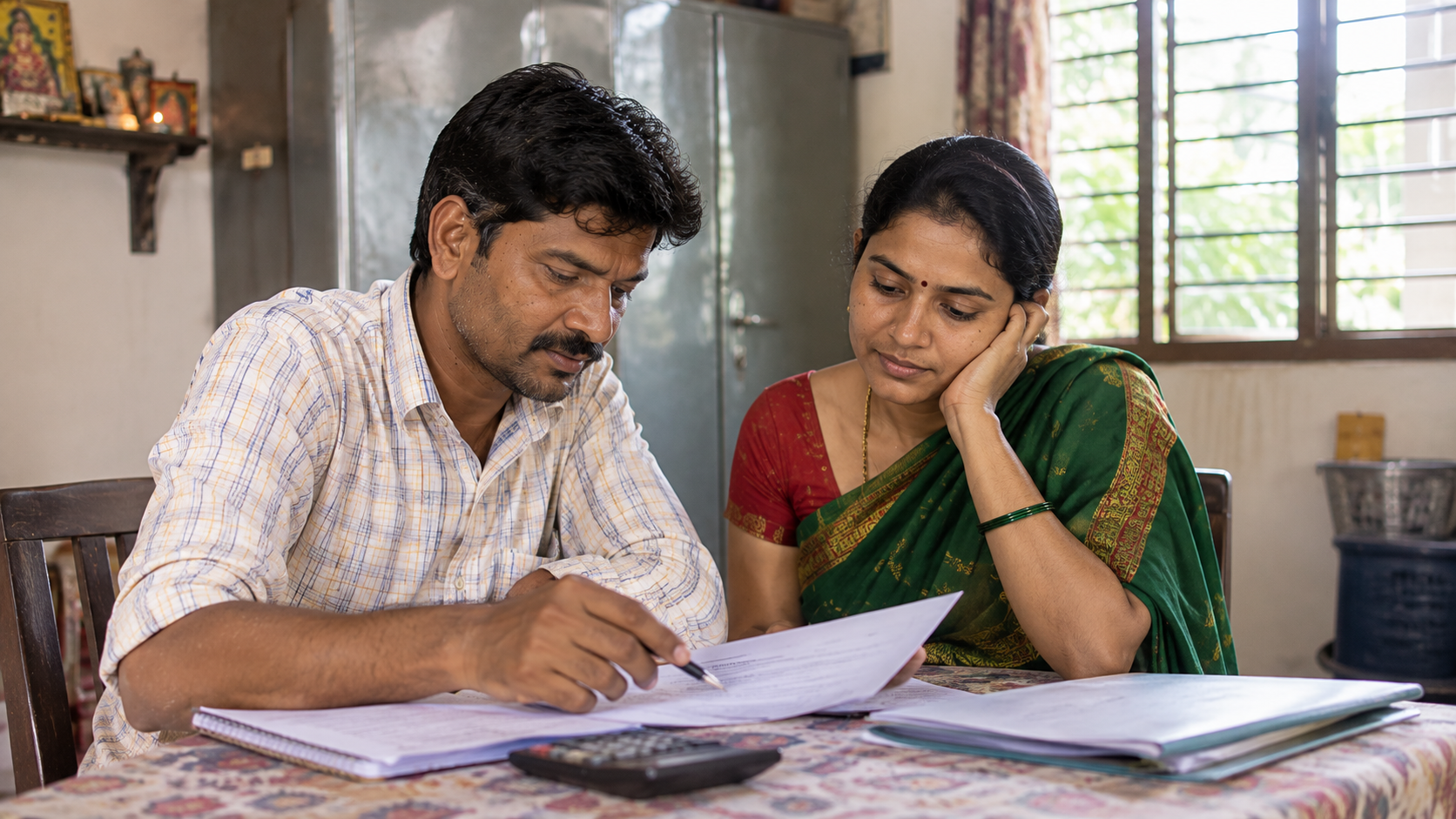
A joint home loan lets two family members, usually spouses or a parent and child, apply together so both incomes count toward how much you can borrow. If both are on the loan and on the property title, and both file under the old tax regime, each can also claim their own home loan tax deductions.
Income is the gap a co-applicant fills most directly. Insufficient income caused 21.5% of credit-decision declines in our data, second only to credit score at 65.4%. This is based on 20,336 credit decisions on home loan enquiries Nivasa Finance handled across Karnataka between September 2024 and September 2026. (For the full picture of where applications stop, see the home loan approval rate in Karnataka.)
This guide covers who to add, how lenders read two incomes and two credit scores, what changed in tax rules from April 2026, and what happens if circumstances change later.
What is a joint home loan?
A joint home loan is one loan taken by two or more people as co-borrowers. Each co-borrower is responsible for the whole loan, not just half of it. If one person stops paying, the lender can ask the other for the full amount still owed.
Is a co-borrower the same as a co-owner?
No. A co-borrower is named on the loan. A co-owner is named on the property papers. To claim tax deductions you need to be both. Many lenders also expect co-borrowers to be co-owners by the time the loan is disbursed, so confirm this before you plan the application.
How much more can you borrow with a co-applicant?
A co-applicant with income the lender can verify raises the EMI you can afford, and that raises the loan amount. Lenders work this out using FOIR (Fixed Obligation to Income Ratio), the share of your monthly income that can go toward all EMIs combined.
Here is an illustration. The 50% FOIR and the 10.5% rate are example figures, not a lender quote.
| You alone | You + spouse | |
|---|---|---|
| Monthly income | ₹40,000 | ₹75,000 |
| EMI allowed at 50% FOIR | ₹20,000 | ₹37,500 |
| Approximate loan, 20 years at 10.5% | ₹20 lakh | ₹37.5 lakh |
Existing EMIs come out of that same limit, for both applicants. Taking on too many existing loans, which lenders call over-obligation, caused 4.7% of credit-decision declines in our data. A co-applicant who brings income but also a large car or personal loan EMI may add less than you expect. To see how tenure changes your EMI, read how to reduce your home loan EMI.
If one of you is self-employed or paid in cash, see how lenders read that income on our pages for self-employed borrowers, cash income borrowers and farmers.
Should your spouse or your parent be the co-applicant?
A working spouse is usually the stronger choice: both incomes count, the tenure is not shortened by age, and both can claim tax deductions. A parent makes sense when your own income is not enough yet and the parent has income a lender can verify, such as a pension, rent or business income.
| Spouse | Parent | |
|---|---|---|
| Income added | Yes, if it can be verified | Yes, if it can be verified |
| Effect on tenure | Usually none, ages are similar | Tenure is limited by the parent's age |
| Tax deductions | Both can claim if both are co-owners | Both can claim if both are co-owners |
| If a co-owner dies | Share usually passes to the surviving spouse and other legal heirs | Parent's share passes to all legal heirs, including siblings |
| Works best when | Both earn and want a larger loan | Your income alone falls short |
When does a spouse co-applicant not help?
A spouse with no income a lender can verify adds ownership, not eligibility. A spouse with a weak credit score can also make the application harder; see the credit score section below. Remember that liability is shared for the life of the loan. Separation or divorce does not end it, and removing a co-borrower needs the lender's approval.
How does a parent's age limit the loan?
Lenders set a maximum age at which the loan must be fully repaid, and they apply it to the older applicant. The exact limit varies by lender. For example, if the limit is 70 and your parent is 55, the longest possible tenure is 15 years, and a 15-year loan has a higher EMI than a 20-year one. Work out the EMI both ways before deciding.
Do women co-applicants get a lower interest rate?
Some lenders in India offer a small concession when a woman is the primary applicant or a co-owner. It is worth asking about. Even a 0.05 percentage point cut on a ₹30 lakh, 20-year loan saves about ₹24,000 in interest at a 10% rate.
How do lenders use two CIBIL scores in a joint application?
Both applicants' credit reports are checked, and lenders differ on how they weigh a gap between the two. Some look at the weaker score, and some focus mainly on the primary applicant. Ask how the lender treats it before you decide who applies with you. Your CIBIL score is a number from 300 to 900 that sums up how you have repaid past loans and credit cards.
Score matters more than anything else in our data. A low credit score caused 65.4% of credit-decision declines. The preliminary offer rate also falls sharply below 650:
| Credit score of applicant | Received a preliminary offer |
|---|---|
| 750 and above | 48.9% |
| 700–749 | 46.3% |
| 650–699 | 41.7% |
| 300–649 | 22.5% |
| No score (no credit history) | 39.6% |
These figures cover applicants screened by Nivasa Finance across Karnataka between September 2024 and September 2026. They are not specific to joint applications. One pattern stands out: applicants with no credit history did better than those with a score below 650, because a thin credit file is treated differently from a damaged one.
What should you do if one co-applicant's score is low?
Check both scores before applying. If one is below 650, fix it first rather than hoping the other score makes up for it. Our guides on credit scores for home loans and home loans with a low CIBIL score cover the steps. If you have already been declined, read home loan rejected: what to check.
What tax benefits do joint home loan borrowers get?
Each co-borrower who is also a co-owner can claim up to ₹2 lakh a year on interest and up to ₹1.5 lakh on principal, but only under the old tax regime and only for a self-occupied home. Under the new tax regime, which has been the default since FY 2024-25, there is no deduction for a home you live in.
What changed from April 2026?
The Income-tax Act, 2025 replaced the 1961 Act from 1 April 2026. The limits did not change, but the section numbers did. Returns for income earned up to 31 March 2026 still use the old numbers.
| Deduction | 1961 Act section | 2025 Act section | Limit per person | Regime |
|---|---|---|---|---|
| Interest, self-occupied home | 24(b) | 22 | ₹2,00,000 a year | Old regime only |
| Principal repayment | 80C | 123 | ₹1,50,000 a year, shared with PPF, ELSS, insurance and others | Old regime only |
| Interest, rented-out home | 24(b) | 22 | No cap, limited by rental income | Both regimes |
Section 80EEA's extra ₹1.5 lakh interest deduction applies only to loans sanctioned between April 2019 and March 2022. It is not available on a new loan.
Worked example: ₹40 lakh joint loan over 20 years
At an example rate of 10.5%, the EMI is ₹39,935. In year 1 you pay ₹4,17,065 in interest and ₹62,157 in principal. Both co-borrowers file under the old regime, split 50:50, and are in the 30% slab.
| Year 1 | Single borrower | Joint, 50:50 |
|---|---|---|
| Principal deduction | ₹62,157 | ₹31,079 each |
| Interest deduction (capped) | ₹2,00,000 | ₹2,00,000 each |
| Total deduction | ₹2,62,157 | ₹4,62,157 combined |
| Tax saved at 30% (before cess) | ₹78,647 | ₹1,38,647 combined |
| Extra saving from joint | N/A | ₹60,000 |
The extra saving shrinks as interest falls each year. Over the first 10 years it adds up to about ₹5.2 lakh, and it reaches about ₹6 lakh by year 15. On a smaller loan where year-1 interest is below ₹2 lakh, one person's cap already covers it and the joint benefit is close to zero.
What else should you know before claiming?
- Each co-borrower claims in proportion to their share of ownership and repayment, which need not be 50:50.
- Both co-borrowers must choose the old regime for the doubling to work. Compare your tax under both regimes first.
- Keep the lender's yearly interest certificate. You need it to claim the interest deduction.
Tax rules change. Check current limits with a chartered accountant before you file.
How do lenders combine two different types of income?
Two salaries with payslips are the simplest case: both are added in full. Other combinations depend on how well the second income is documented, and treatment varies by lender.
| Income combination | How it is usually assessed |
|---|---|
| Both salaried, with payslips | Both incomes added in full |
| One salaried, one self-employed with ITR | Salary in full; business income as shown in 2–3 years of ITR |
| Both self-employed | Combined ITR income, with a consistent filing history for both |
| Parent on pension | Pension usually counted; documented rent too |
| One salaried, one paid in cash or self-employed without ITR | Lenders that require ITR often leave the second income out. Nivasa Finance works with partner banks and NBFCs that can assess income from bank statements, so share it rather than leaving it out |
In our data, 27.3% of enquiries with an income type recorded were salaried through a bank account or self-employed with three years of ITR (n=7,123, November 2024 to August 2026). The rest had cash or non-ITR income, which is why choosing the right home loan for your income type matters so much.
What documents does a joint home loan need?
Both applicants need identity, income and relationship papers. Property papers are needed once.
| Document | Primary applicant | Co-applicant |
|---|---|---|
| Identity | Aadhaar, PAN | Aadhaar, PAN |
| Income, salaried | Last 3 months' payslips, 2 years' Form 16, bank statements | Same |
| Income, self-employed | 2–3 years' ITR with computation, business proof, 6–12 months' bank statements | Same |
| Income, pension | N/A | Pension order (PPO), bank statements showing the credit |
| Relationship proof | N/A | Marriage certificate for a spouse; birth certificate or family tree for a parent |
| Property | Sale deed, khata, encumbrance certificate, tax receipt, approved plan | Needed if the co-applicant is a co-owner |
| Photo and signature | Yes | Yes |
The khata is the local body's property record that shows who owns the property and pays its tax. Our guide to khata types and home loan eligibility explains which type lenders accept. If you are building on your own plot, see our home construction loan page. Budget for the fees too: here is every home loan charge in Karnataka.
What happens if circumstances change after the loan?
Nothing about a joint loan changes automatically. Removing a person, a death or a separation each needs a formal step with the lender, the property title, or both.
Can a co-borrower be removed from the loan?
Only if the lender agrees and the remaining borrower qualifies alone for the amount still owed. The lender reassesses income, credit score and existing EMIs as if it were a new application. Taking someone off the property title is a separate legal step, such as a gift deed, sale deed or family settlement deed, each with its own stamp duty. Speak to a property lawyer first.
What happens if a co-borrower dies?
The surviving co-borrower becomes responsible for the full outstanding loan. The deceased person's share of the property passes to their legal heirs, who may include people other than the surviving borrower. A will, and loan protection insurance on both co-borrowers, reduce this risk.
What if the relationship breaks down?
The loan stays joint until the lender agrees to change it. Both people remain liable for the full amount. Consider this before applying with a partner you are not married to.
About Nivasa Finance
Nivasa Finance is a home loan distribution company serving 23 districts across rural and semi-urban Karnataka, through branches in Mysuru, Mandya, Hassan, Hosapete, Davanagere, Belagavi, Hubballi, Bagalkot, Shivamogga, Raichur and Tumkur. It arranges home construction and improvement loans, loans against property, and balance transfers with top-up from ₹5 lakh to ₹50 lakh, through a network of RBI-regulated partner banks and NBFCs, with zero commission charged to the customer. Here is how this differs from applying directly to a bank.
Find your nearest branch or check your eligibility online, with or without a co-applicant.